A Real-World Multimodal and MultiWeather Traffic Dataset for Studying Chaotic Agents in Heterogenous Environments
The Indian Driving Scenes - Jodhpur Dataset for Heterogenous Environment Analysis IDS-JODHA dataset is an observational tool for studying complex systems and a challenging benchmark for perception algorithms. Collected on live urban roads in Jodhpur, India, it captures the dense, unstructured, and heterogeneous traffic dynamics that are underrepresented in existing datasets.
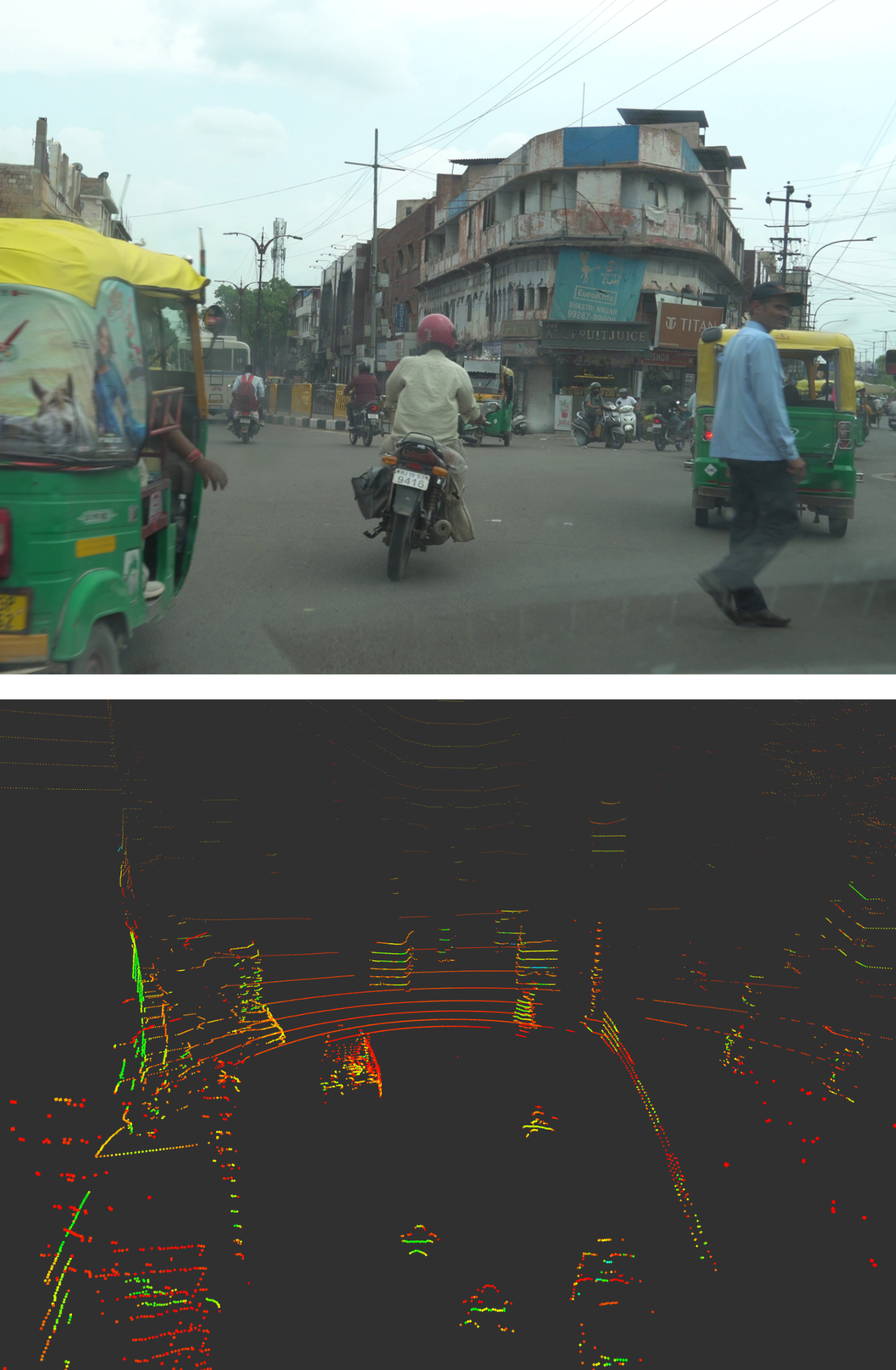
Height-colored top-down LiDAR scan
Total Duration
Total Camera Frames (4K @ 25 FPS)
LiDAR Scans (VLP-16 @ 10 Hz)
Understanding the principles of self-organization in complex systems is a fundamental scientific challenge. Urban traffic in unstructured environments, such as those in India, represents a remarkable, yet understudied, real-world instance of such a system. It provides a natural laboratory for investigating how macroscopic order emerges from the chaotic, local interactions of numerous independent agents.
Unlike regulated environments, Indian roads exhibit chaotic patterns with a high diversity of agents and a general lack of lane discipline, making them a significant test for modern perception systems.
Most established benchmarks like KITTI and nuScenes are collected in structured environments, filtering out the complex phenomena of interest. While previous Indian datasets have made progress, a critical barrier persists for the empirical validation of traffic flow and complex systems theories in the real world.
IDS-JODHA directly addresses this gap by providing a purpose-built scientific instrument for the empirical study of unstructured traffic dynamics, capturing the dense, organic interactions essential for this research.
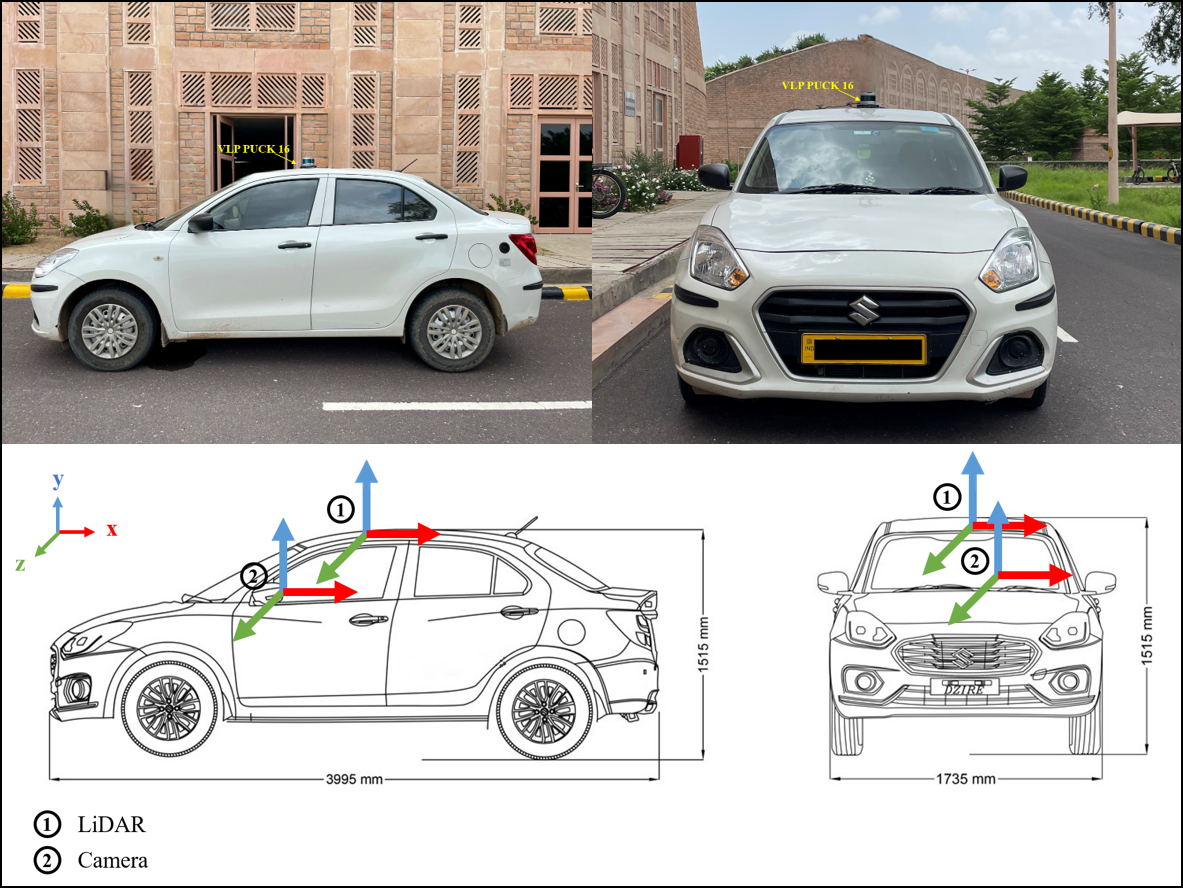
The sensor suite was mounted on a passenger vehicle. The camera was attached to the dashboard using a DJI Ronin-SC gimbal for active stabilization, while the LiDAR was positioned on the roof for an unobstructed view. Data was logged using a high-performance laptop powered by a dual UPS configuration.
Sensor mounting and coordinate frames.
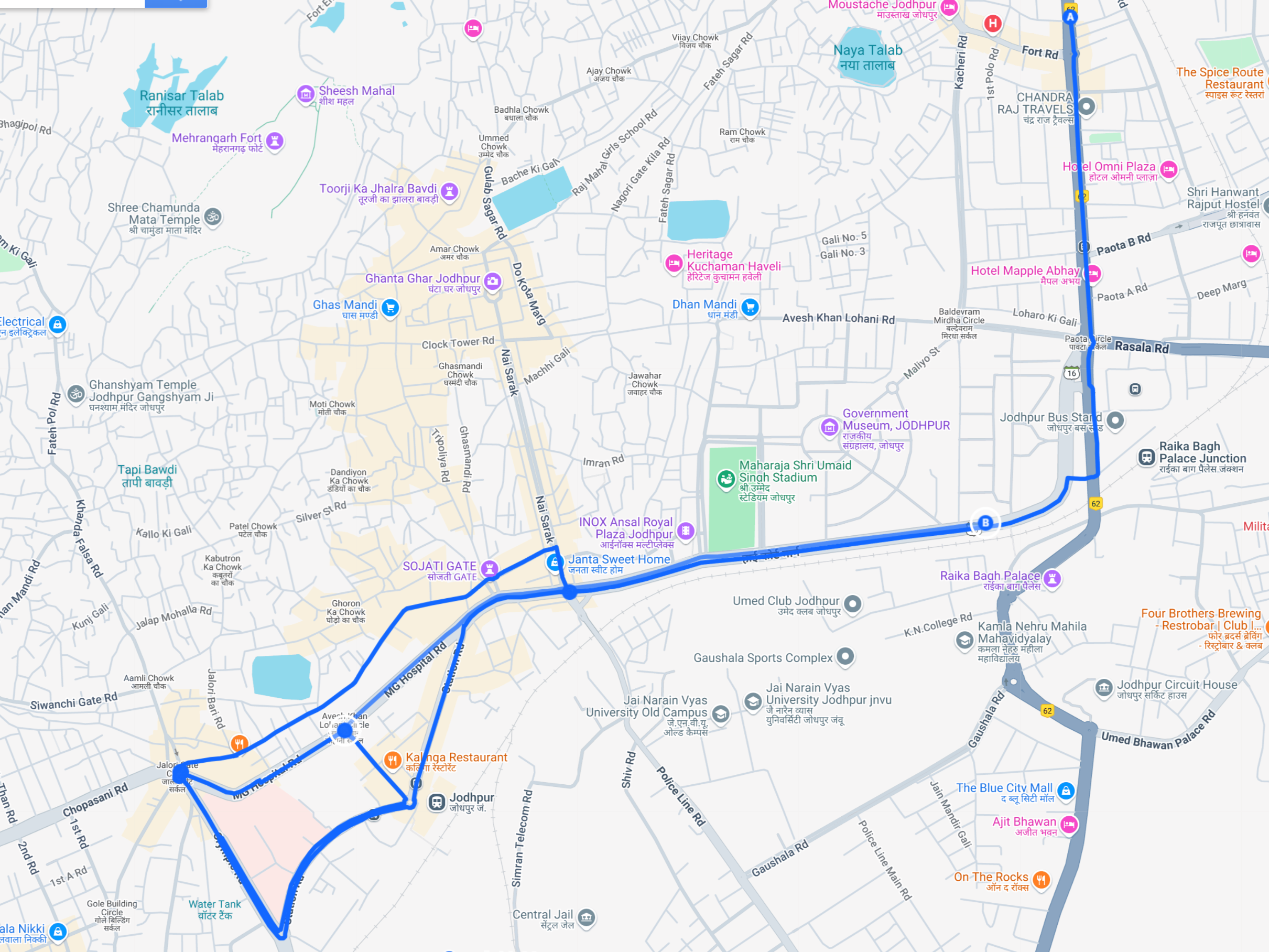
Data collection route for the clear-weather sequence through Jodhpur.
Benchmark 3D object detection, tracking, and segmentation models in dense, occluded scenarios and adverse weather conditions.
Develop and validate behaviorally accurate trajectory prediction models for vulnerable road users and vehicles in mixed traffic.
Use dense agent trajectories to empirically test theories of traffic flow, self-organization, and criticality in a real-world, chaotic system.
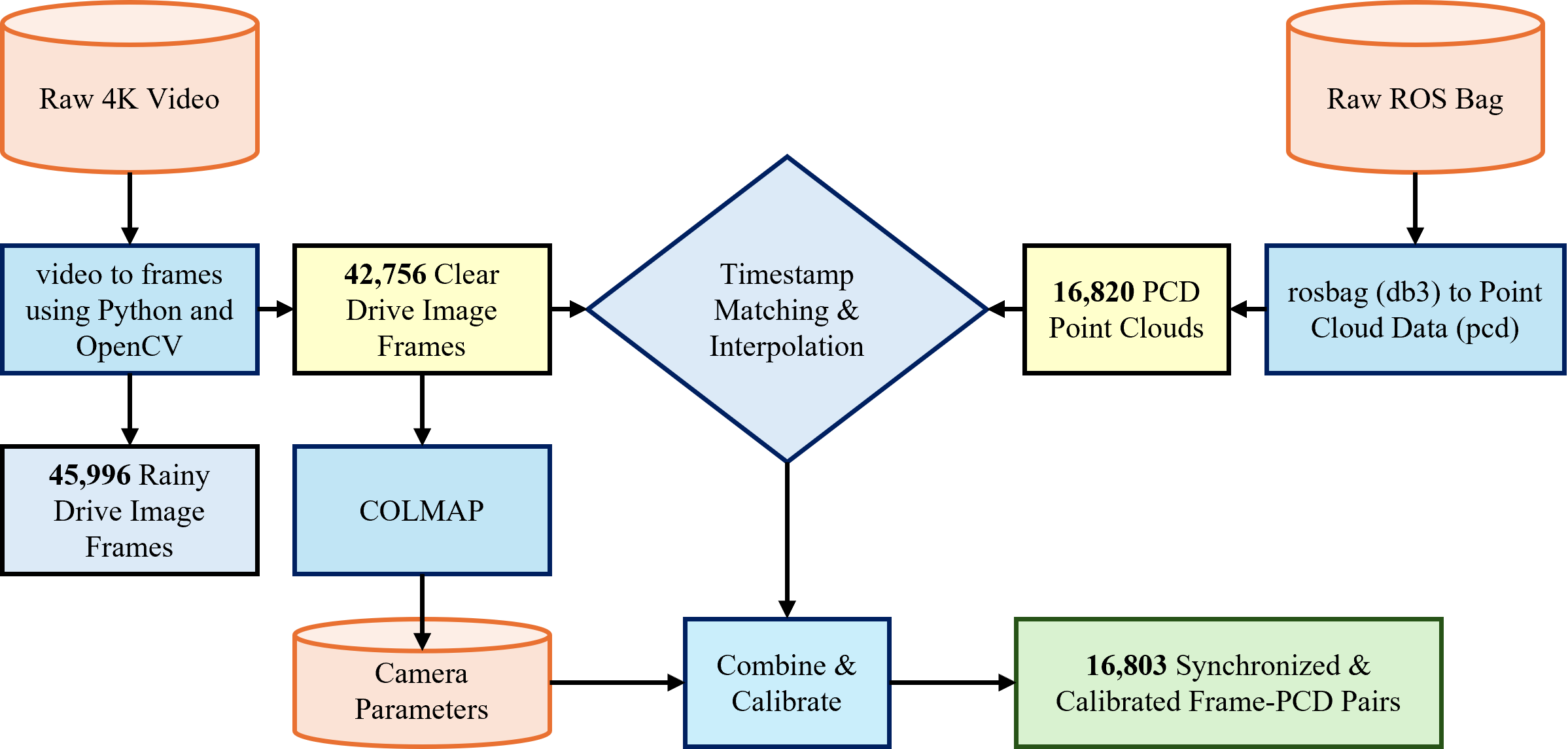
Raw sensor recordings were transformed into a structured, analysis-ready format through a systematic preprocessing pipeline designed to ensure data integrity, temporal consistency, and calibration accuracy.
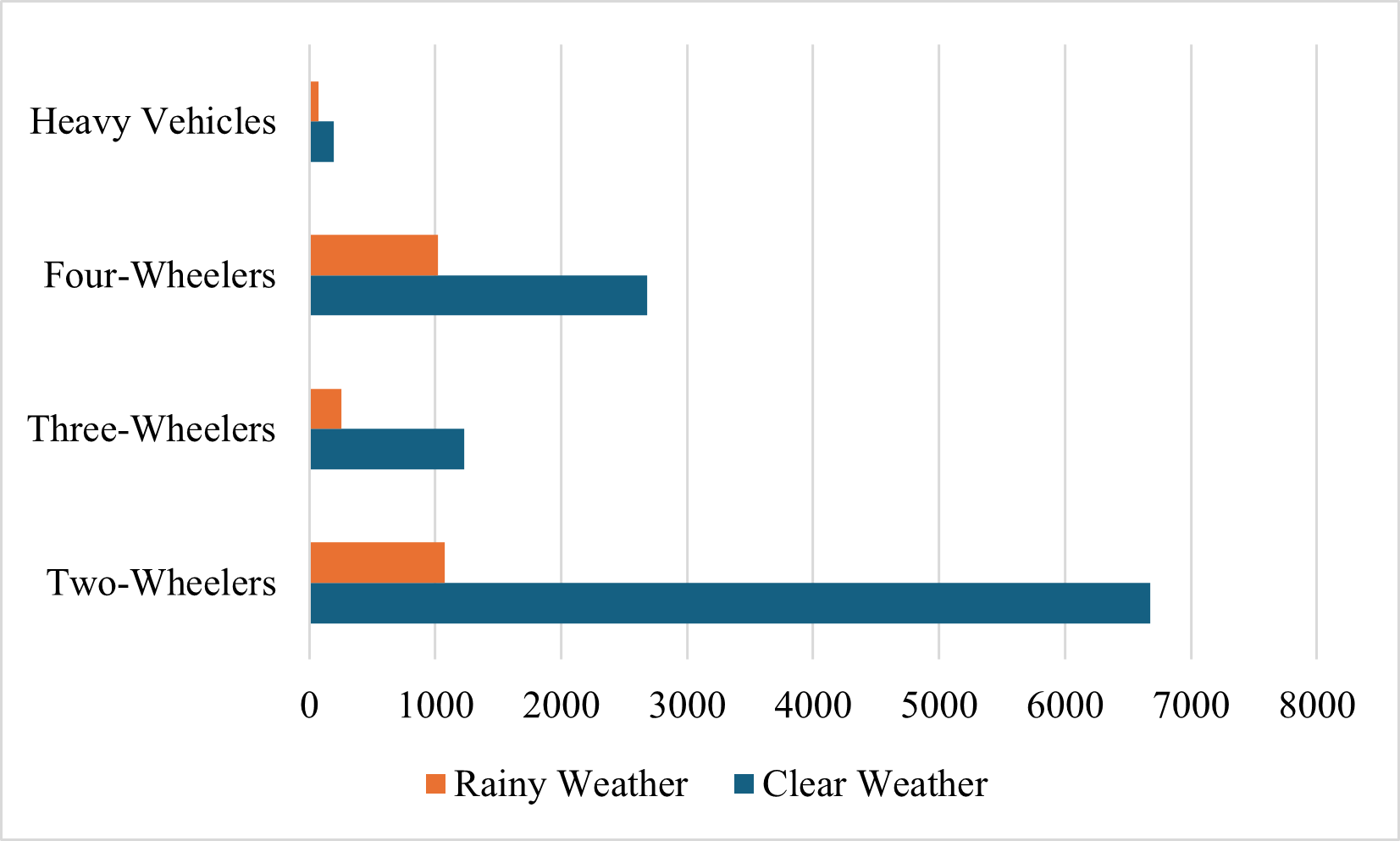
To demonstrate the dataset's utility, a baseline vehicle detection and counting pipeline was implemented. The analysis reveals a significant variance in traffic composition based on weather conditions.
During rainy conditions, a dramatic behavioral shift occurs: the volume of Two-wheelers, which are the dominant vehicle class in clear weather, decreases by approximately 85%. Consequently, Four-wheelers become an equally dominant traffic component, highlighting a critical adaptation strategy by commuters.
Comparative analysis of traffic composition.
The dataset is organized into the following modular directory structure.
IDS-JODHA/
├── Monocular Rain Data/
│ └── video_frames/
├── Multi-Modal Dataset/
│ ├── lidar_rosbag/
│ ├── synced_frames/
│ └── video_frames/
├── codes/
│ ├── frame_extract.ipynb
│ ├── generated_synced_dataset.py
│ ├── manual_sync_viewer.py
│ └── points2pcd.py
└── metadata/
├── camera_calibration.yaml
└── sync_config.json
The IDS-JODHA dataset, hosted on the Zenodo repository, is available for academic and research purposes under the Creative Commons Attribution 4.0 International License.
Access Link
Associate Professor
Department of Civil and Infrastructure Engineering, and
School of Artificial Intelligence and Data Science
Indian Institute of Technology Jodhpur
MS Research Scholar
School of Artificial Intelligence and Data Science
Indian Institute of Technology Jodhpur
Research Intern (SIP-SAIDE 2025)
School of Artificial Intelligence and Data Science
Indian Institute of Technology Jodhpur